
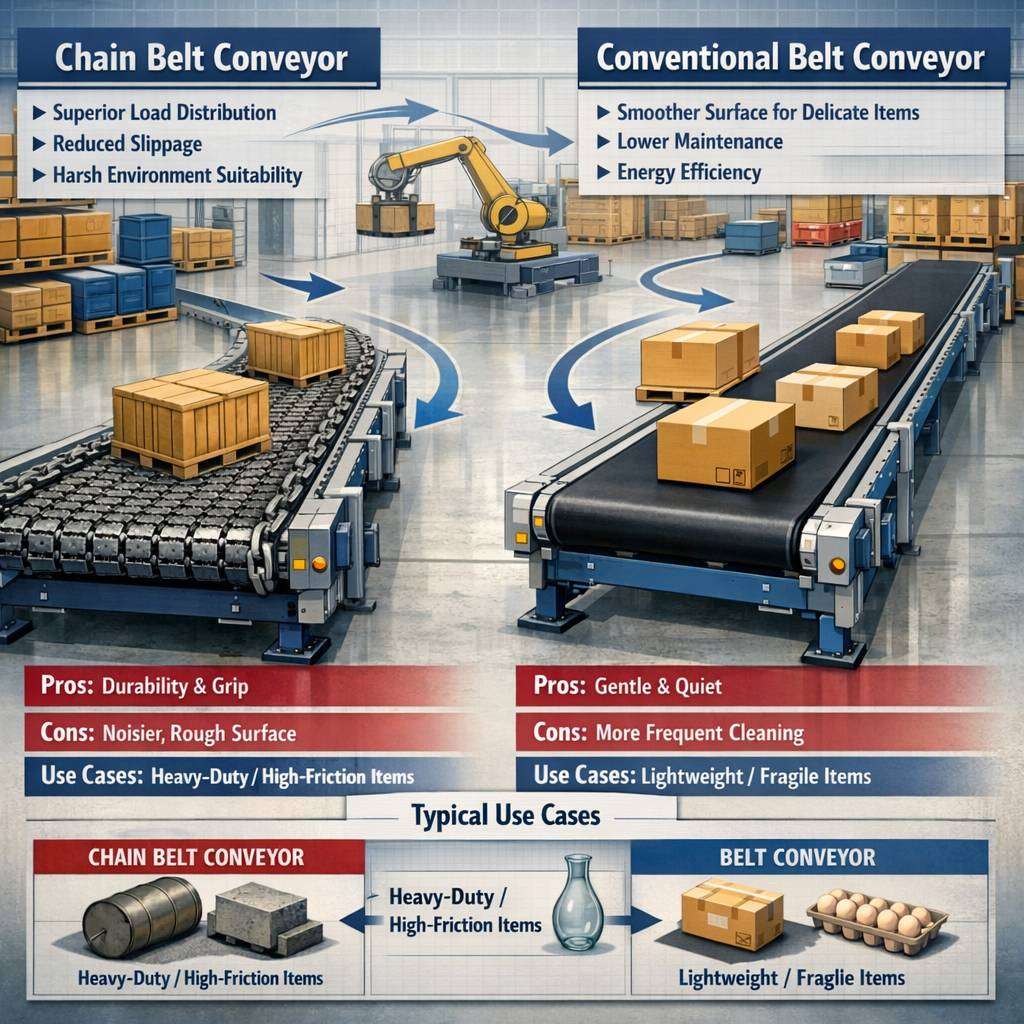
A chain belt conveyor system enhances throughput in compact plants, delivering reliable, steady movement of heavy loads with minimal space. Its rugged design reduces maintenance while supporting continuous operation. For readers curious about applied conveyor theory, visit the link below for context on conveyors in meteorology that mirrors belt dynamics: https://www.ecmwf.int/en/newsletter/154/meteorology/why-warm-conveyor-belts-matter-nwp. The concept translates well to industrial chain belt efficiency.
When evaluating material handling solutions, many organisations in the UK reference belt conveyor systems as a reliable backbone for production lines, warehousing, and packaging operations. Two prominent options are the chain belt conveyor and the conventional belt conveyor. Each type brings distinct advantages and limitations, depending on speed, load, product characteristics, and the environment. This article explores their pros, cons, and typical use cases to help you decide which is most appropriate for your operations.
What is a chain belt conveyor?
A chain belt conveyor uses a chain-driven belt surface to transport items along a securely guided path. The chain provides robust support and can be engineered to accommodate heavy loads, frequent starts and stops, or severe temperature variations. Chain belt conveyors are commonly employed in high-duty environments such as manufacturing floors, cold stores, and automotive assembly lines. They are often selected for their durability and predictable wear patterns, which can translate into longer service intervals for certain applications.
What is a conventional belt conveyor?
Conventional belt conveyors rely on a continuous belt loop that runs over rollers or pulleys. This design is widely adopted due to its simplicity, smooth transfer of goods, and suitability for a broad range of products. Belt conveyor systems can be configured for light, medium, or heavy-duty tasks and are frequently used in material handling, packaging, and distribution centres. The availability of belt conveyor manufacturers near me, as well as belt conveyors UK suppliers, has driven widespread adoption in varied sectors.
Pros of a chain belt conveyor
- High load capacity and robustness: The chain-driven surface can support heavy weights and resist deformation, making it well suited to demanding applications.
- Enhanced traction and reduced slippage: The chain surface maintains consistent contact with the drive system, improving motion control, especially with angular or irregular items.
- Better performance with hot or especially cool environments: Chain belt conveyors can be engineered to withstand temperature extremes where rubber or fabric belts may suffer.
- Improved resistance to damage from snagging or punctures: The chain backing offers a stiff, durable platform that can handle rugged handling scenarios.
Cons of a chain belt conveyor
- Higher initial cost: The materials, drive components, and maintenance requirements tend to be more expensive than conventional belt systems.
- Greater maintenance needs: Chains and associated bearings require lubrication, tensioning, and periodic inspection to maintain performance and longevity.
- Less gentle handling for delicate products: The rigid chain surface may transfer more impact to sensitive items, potentially increasing product damage if not properly configured.
- Longer lead times for custom configurations: Chain belt conveyors often require bespoke engineering, which can affect lead times when sourcing from belt conveyor manufacturers near me.
Pros of a conventional belt conveyor
- Versatility and gentle handling: The continuous belt provides smooth motion and is adaptable for a wide variety of products, from bulk materials to small parts.
- Lower upfront cost and easier installation: Standard belt systems benefit from mature supply chains, faster procurement, and simpler maintenance.
- Simple maintenance and parts availability: Belts, rollers, and drives are widely stocked, with many service providers offering support, particularly in belt conveyors UK networks.
- Broad product compatibility: The belt can accommodate different textures, coatings, and materials to suit specific product handling needs.
Cons of a conventional belt conveyor
- Slippage and tracking issues: Belts can wander or slip under heavy loads or misalignment, requiring regular adjustments.
- Susceptibility to damage from sharp or hot items: Belts can wear more quickly when exposed to extreme temperatures or abrasive materials.
- Limited resistance to heavy impacts: Very high payloads or rough handling can strain belt life, especially on high-speed lines.
- Potential for higher maintenance in coastal or humid environments: Corrosion or moisture can affect rollers and frames, necessitating preventive measures.
Use cases for a chain belt conveyor
- Automotive or heavy manufacturing lines: Where robust, consistent traction and load distribution support high throughput in challenging environments.
- Cold storage or freezer facilities: Chain belt conveyors can be custom-configured to operate reliably at low temperatures with minimal belt degradation.
- Applications requiring precise positioning or alignment: The chain surface can provide stable, repeatable motion critical for assembly tasks.
- Environments with abrasive or sharp-edged products: The chain-backed surface offers higher resistance to punctures and cuts than some conventional belts.
Use cases for a conventional belt conveyor
- General material handling and packaging lines: Where versatility, gentle handling, and cost efficiency are priorities.
- Light to medium-duty transport tasks: Belt systems are well-suited for moving small parts, boxes, and stacked goods.
- Long continuous runs with minimal product handling: Belt conveyors can cover extensive distances with reduced maintenance demands.
- Facilities looking for readily available parts and service: The broad ecosystem of belt conveyor systems for sale and UK suppliers makes maintenance straightforward.
Key decision factors
- Product characteristics: Delicate items or those requiring gentle handling may favour conventional belt conveyors, while heavy, abrasive, or temperature-extreme products may suit chain belt conveyors.
- Throughput and durability needs: For high-speed, high-load processes, chain belt conveyors can offer advantages in traction and stability.
- Environmental conditions: Exposed or extreme environments might necessitate the tougher construction of chain belt systems.
- Total cost of ownership: Initial purchase price, maintenance regimes, and energy consumption should be weighed against expected uptime and productivity.
A chain belt conveyor offers reliable material handling with strong traction and smooth transport across long runs. It efficiently moves heavy loads while minimizing slippage, making it ideal for manufacturing lines and packaging setups. For more components and accessories, visit https://conveyorrollers.co.uk and explore scalable solutions that fit your operations.ersistent performance and durable construction ensure longevity.
The chain belt conveyor combines compact design with high-efficiency transport, ideal for tight spaces and demanding industrial lines. It offers reliable load handling, smooth movement, and minimal maintenance thanks to robust chain segments and precision timing. For durability and enhanced sealing in challenging environments, explore solutions at https://www.trelleborg.com/en/seals-and-profiles/products-and-solutions/conveyor-belts/chevron-surface-belts. This system is especially suited to food processing, packaging, and assembly lines that require consistent belt tension and reduced downtime.
Practical considerations for procurement
- Build a shortlist of reputable belt conveyor manufacturers near me, and compare specifications, warranties, and service packages.
- Consider after-sales support, spare parts availability, and the global or regional reach of suppliers, particularly for belt conveyors UK operations.
- Evaluate whether you need a powered belt conveyor, which can be combined with automated controls, sensors, or integration with warehouse management systems.
- Request site assessments or trials to observe performance with your actual product mix and line layout.
Choosing between a chain belt conveyor and a conventional belt conveyor requires aligning the strengths of each design with your specificOperational demands. By weighing load requirements, product handling characteristics, environmental factors, and total cost of ownership, you can identify the solution that delivers the best long-term value for belt conveyor systems in your facility. Whether you are sourcing a belt conveyor small for tight spaces or a larger powered belt conveyor for a high-throughput line, the right choice will optimise efficiency, safety, and productivity across your operation.